 English
Our Temperature & Humidity Mapping Service for storage systems (cold rooms, cool rooms, freezers, stability chambers) is a core technical solution helping businesses ensure product quality and strictly comply with GSP, GMP, and WHO standards.
Temperature & Humidity Mapping & Qualification Service for Storage Warehouses (Mapping IQ/OQ/PQ)
In the management and operation of warehouses for pharmaceuticals, vaccines, biological products, or high-end food, ensuring environmental conditions remain stable in real-time across all locations is a mandatory requirement. NTTEK provides end-to-end solutions for temperature and humidity mapping and warehouse qualification, fully meeting standards such as Circular 36/2018/TT-BYT (GSP), GMP, WHO, and ISPE.
1. Why Is Storage Warehouse Temperature & Humidity Mapping Necessary?
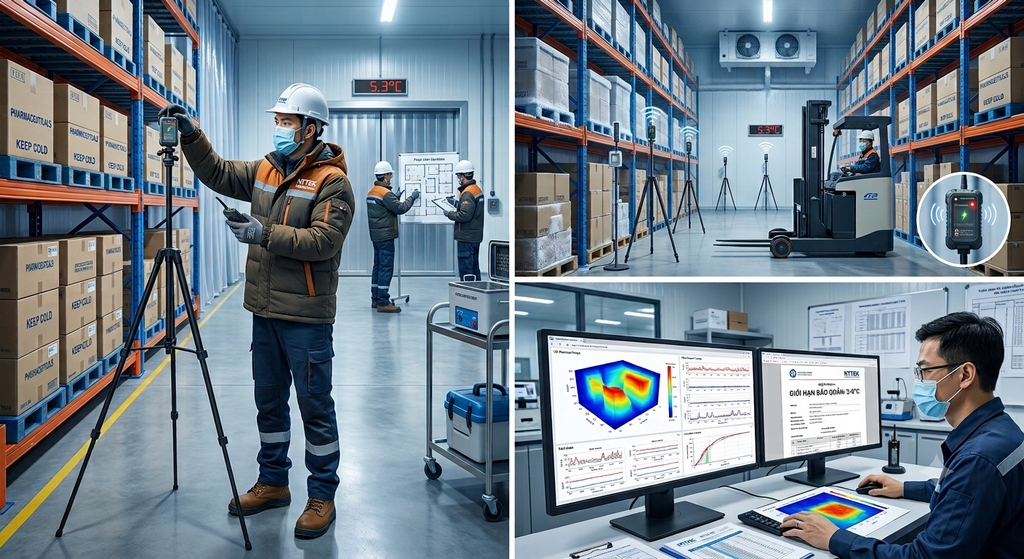
Storage warehouses with large spaces, convection airflow, and varying loading positions often develop temperature variations (“Hot Spots” and “Cold Spots”). Performing Mapping provides practical benefits:
- Regulatory compliance: Meets mandatory requirements of the Ministry of Health (Circular 36/2018/TT-BYT) and international GSP/GMP standards for pharmaceutical and vaccine storage.
- Identification of Critical Points: Pinpoints high-risk locations to position continuous monitoring sensors or identify areas where goods should not be stacked.
- HVAC/Refrigeration system optimization: Evaluates airflow distribution efficiency, thermal recovery time during door openings, or temporary power outages.
- Minimization of product loss: Ensures temperature-sensitive products maintain their quality throughout storage.
2. Scope of Mapping & Qualification Services at NTTEK
We deploy diverse services across multiple systems and temperature ranges:
| Equipment / Warehouse Type | Standard Temperature Range | Main Applications |
|---|---|---|
| Cold Room | 2°C – 8°C | Vaccines, biological products, sensitive pharmaceuticals |
| Cool Room | 15°C – 25°C or 15°C – 30°C | Medicines, pharmaceutical ingredients, health supplements |
| Freezer Room / Deep Freezer | -18°C to -80°C | Serum, biological samples, frozen food |
| Specialized Storage Cabinets | 2°C – 8°C / 15°C – 25°C | Pharmacy medicine cabinets, laboratories, hospitals |
Accompanying qualification documentation packages:
- Consulting & protocol preparation for IQ (Installation Qualification)
- Protocol preparation & execution for OQ (Operational Qualification)
- Protocol preparation & execution for PQ (Performance Qualification under un-loaded and loaded conditions)
3. When Should Businesses Perform Mapping?
- Initial Mapping: For newly installed warehouses/cabinets prior to final acceptance and official operation.
- Re-mapping: Performed periodically (typically every 12–24 months) or seasonally (Summer/Winter) to assess the impact of external weather conditions.
- Change Control Mapping: Following major repairs to the refrigeration system, structural modifications to the warehouse, equipment relocation, or major technical incidents.
4. NTTEK Standard WHO & ISPE Execution Process
- Survey & Protocol Preparation — Measure actual dimensions (Length x Width x Height) to determine warehouse volume. Calculate sensor quantities and map sensor placement locations (including corners, center, near doors, and near cooling units).
- Quotation & Confirmation — Provide short-term/long-term rental quotes and execute contracts.
- Preparation of Specialized Measuring Equipment — Utilize data loggers (Data Logger / EDLM) with appropriate measurement ranges, high accuracy (±0.2°C to ±0.5°C), valid calibration, and full certification stickers.
- Installation & Continuous Data Logging — Place Data Loggers at approved positions. Set sampling frequency (minimum 1–5 minutes or 30 minutes depending on requirements). Continuous monitoring duration:
- Cold Room (2–8°C): Minimum 72 hours
- Cool Room (15–25°C): Minimum 168 hours (7 days)
- Perform additional stress tests: Door Open Test, Simulated Power Failure Test.
- Data Extraction & Reporting — Collect data, analyze spatial and temporal temperature and humidity variations. Export graphs, summary tables for maximum (Tmax), minimum (Tmin), average (Tavg) temperatures, and standard deviations.
- Conclusion & Recommendations — Evaluate uniformity, precisely identify Hot Spots / Cold Spots. Issue official qualification reports along with calibration certificates for measuring instruments.
5. NTTEK Capabilities & Commitments
- Modern equipment: High-precision Data Logger systems meeting strict standards for secure data storage.
- Expert team: Highly experienced in calibration, verification, and GSP/GMP dossier consulting for pharmaceutical corporations and cold-chain logistics providers.
- Cost & time optimization: Provide flexible survey and execution plans without interrupting customer business operations.
- Compliant reporting: Fully legally compliant reports, supporting businesses during audits by the Drug Administration / Department of Health.